
Delivery Pipes, Elbows, Couplings and End Hoses: How to Choose and Inspect
The delivery line touches the concrete along its whole length, so it wears in places you cannot see. This guide shows how to measure, order and inspect.
Published
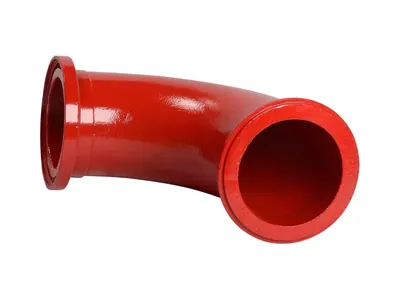
Parts of the line
| Part | What identifies it |
|---|---|
| Delivery pipe | Nominal diameter (such as 5.5 or 6 inch), wall thickness, length and end type. |
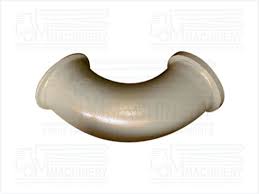
| Elbow | Diameter, angle and radius, as in “Elbow 6"”. |
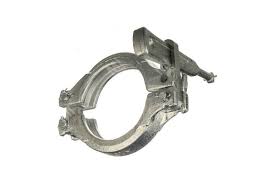
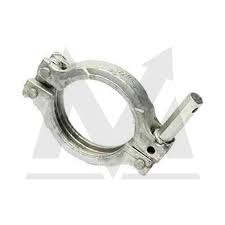
| Coupling (clamp) | Joins two pipes and is sized by pipe diameter and lock type, as in “Clamp Coupling 6"”. |
| Rubber seal (gasket) | Sits inside the coupling, wears quickly and is ordered by pipe diameter. |
| End hose | Length and flange type, as in “End Hose 4 Mtr Double Flg”. |
How to measure
- Nominal diameter: in inches or millimetres (DN), the size your machine goes by.
- Wall thickness, length and coupling type. Mix-ups are common here, so photograph both ends.
- Do not assume one make's coupling fits another make's pipe; confirm the match. See how to find the part number.
Signs of wear and working safely
- The wall thins from the inside under the concrete, and the pipe may look fine outside. Test it with a thickness gauge, or watch for bulging, rust spots or weeping at the ends.
- Slurry leaking from a coupling means a worn gasket or a loose coupling.
- Elbows wear faster than straight pipe because the concrete hits their outer wall.
- A worn pipe under pressure can burst. Replace it before it cracks, and do not stand beside the line while pumping.
The end hose
The end hose wears fast because it moves and rubs. Do not use it once the reinforcement wire shows, or if it bulges or cracks. Order it by length and flange type (single or double), and see hoses and pipes and couplings. For the other parts that wear, see concrete pump wear parts.
Parts from the catalogue
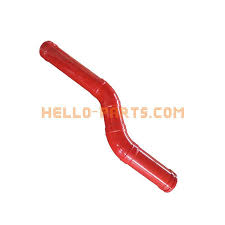
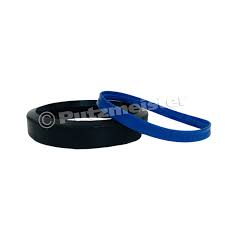
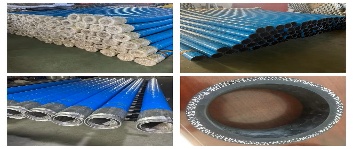
Related categories
Quick questions
What do 5.5 and 6 inch mean?
They are the nominal diameter of the delivery pipe in inches. The pipe, elbow and coupling must match in this size.
How often should I replace delivery pipes?
There is no fixed date. It depends on the volume and type of concrete, so the basis is regular measurement of the wall thickness.
Is the end hose a wear part?
Yes. It wears quickly and should be inspected and replaced when the wire, a bulge or a crack shows.
Can I use a coupling from a different make?
Do not assume so. Confirm the diameter, the lock type and the end shapes, and send a photo of the pipe and coupling so we confirm the match.
Read next
- Concrete Pump Wear Parts: What Wears Out and When to Replace ItThe main wear parts of a concrete pump: spectacle plate, cutting ring, S-valve, pistons, pipes and elbows. Signs of wear and what to replace together.
- Concrete Pump Parts and Their Names in Arabic and English: A Plain GlossaryNames of concrete pump parts in Arabic and English: hopper, agitator, S-valve, spectacle plate, cutting ring, delivery cylinders and cooler, with what each part does.
- Spectacle Plate and Cutting Ring: Signs of Wear and When to Replace ThemWhen to replace the spectacle plate and cutting ring on a concrete pump: signs of wear, why they are replaced as a pair, and what to send us so we identify the right parts for your pump.
- Hydraulic Oil Overheating in a Concrete Pump: Causes and What to Check FirstWhy the hydraulic oil overheats on a concrete pump: cooler and fan, oil level, filters and pump wear. A check order from easiest to hardest.
- Concrete Pump Slow or Weak Output: Possible Causes and What to CheckIf a concrete pump's output drops: check the concrete and the line, then the spectacle plate and cutting ring, the delivery pistons, the filters and the hydraulic pump. A table of symptoms and causes.
- Concrete Pump Maintenance Checklist: After Every Pour, Daily and Periodic ChecksA practical concrete pump maintenance checklist: cleaning after pumping, daily oil and water checks, and periodic checks of filters and wear parts. Exact intervals come from your machine's manual.
- Blog
- Heavy equipment parts